SFX Meaning: What Sound Effects Mean in Video and Film

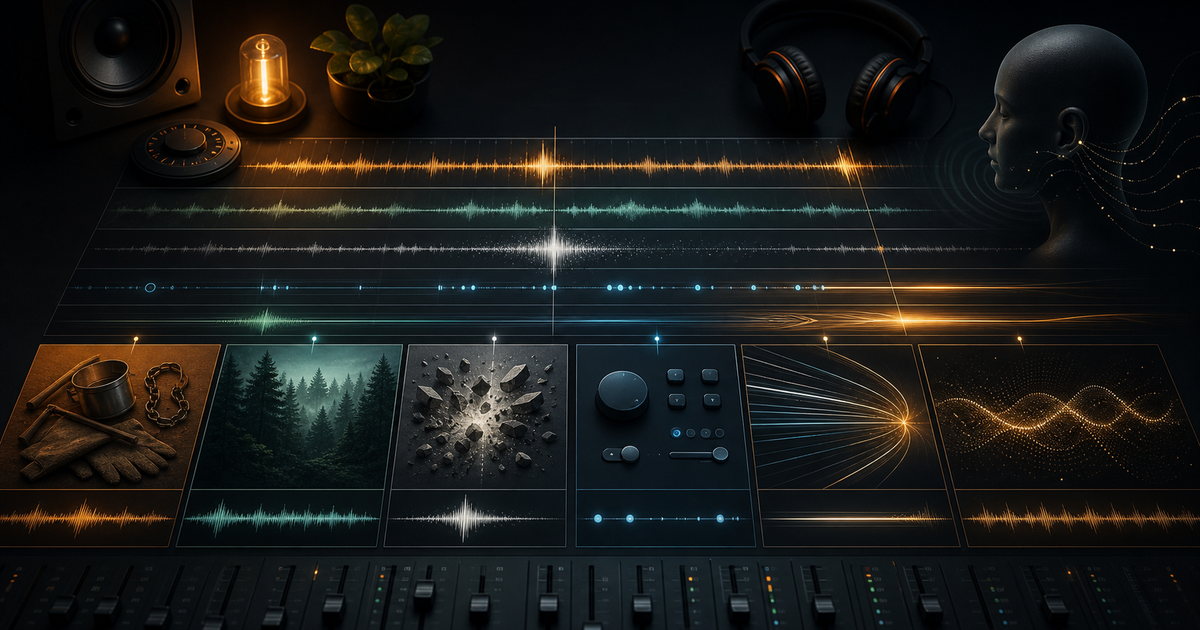
Quick answer: the SFX meaning most editors need is sound effects. SFX means sound effects in most audio, video, film, game, podcast, and editing contexts. SFX are the non-dialogue sounds that make actions, places, transitions, interfaces, and emotional beats feel clear. Footsteps, door slams, whooshes, impacts, room tone, rain, UI clicks, creature sounds, cartoon boings, glass breaks, and cinematic hits are all SFX.
The confusing part is that SFX can also mean special effects in some visual-effects conversations. Context tells you which meaning is intended. If someone is talking about a video edit, sound library, foley, ambience, or audio timeline, SFX almost always means sound effects. If they are talking about practical explosions, makeup, miniatures, or on-set visual tricks, they may mean special effects.
Use the player below to hear 20 royalty-free examples across common SFX families. Then use the guide to understand what each category does, how editors choose sounds, and why sound effects matter more than beginners expect.
SFX meaning in one sentence
SFX means sound effects: audio elements added, recorded, performed, edited, or designed to support action, environment, rhythm, emotion, and clarity in media.
That definition is simple, but the category is enormous. A YouTube video might use clicks, swipes, risers, and impacts. A film scene might use room tone, footsteps, cloth, door creaks, glass, wind, and distant traffic. A game might use UI dings, weapon layers, magic bursts, footsteps, power-ups, creature sounds, and ambience loops.
SFX vs VFX vs foley vs ambience
| Term | Meaning | Example |
|---|---|---|
| SFX | Sound effects used in media | Whoosh, thud, footstep, door slam, UI click |
| VFX | Visual effects created or added to picture | Creature animation, screen replacement, digital explosion |
| Special effects | Often practical effects made physically on set | Squibs, smoke, rain rigs, practical fire, makeup effects |
| Foley | Performed sound effects synced to picture | Footsteps, cloth, hand props, body movement |
| Ambience | Background sound that creates place | City night, office room tone, forest, ocean, crowd |
| Music | Score, songs, beds, themes, and cues | Suspense drone, intro theme, orchestral cue |
These categories overlap in real projects. Foley is a type of SFX. Ambience is often filed with sound effects even though it behaves like a bed. A dramatic riser may feel musical but function like a transition effect. The name matters less than the job the sound performs in the edit.
Why SFX matter
Picture can show an action, but sound tells us how to feel it. A cup placed on a table can be gentle, tense, careless, funny, or threatening depending on the sound. A door opening can mean welcome, danger, interruption, secrecy, or relief. A phone tap can feel modern and clean, cheap and plastic, magical, annoying, or invisible.
SFX also solve practical editing problems. They hide cuts, connect shots, explain off-screen events, make interfaces responsive, create rhythm, sell scale, and keep the audience oriented. Without sound effects, even expensive footage can feel unfinished.
Common types of SFX
- Foley: footsteps, cloth, hands, props, body movement.
- Impacts: hits, thuds, booms, punches, drops, slams.
- Transitions: whooshes, risers, reverses, swells, stingers.
- Ambience: room tone, city beds, weather, crowds, nature, interiors.
- UI sounds: clicks, taps, notifications, confirms, errors, hovers.
- Designed sounds: creatures, magic, sci-fi, glitches, power-ups, impossible objects.
- Comedy sounds: boings, pops, squeaks, scratches, little whacks, reactions.
If you are building a basic SFX library, cover each family. A folder full of only huge impacts will not help when you need cloth movement, room tone, UI feedback, or a small comic button.
SFX examples to study
Foley as performed sound effects
This is a clear example of foley as SFX. The artists are not just making noise. They are performing timing, weight, and character to match picture.
How movie sounds are built from unexpected sources
This is the sound designer mindset: the source can be strange as long as the result communicates. SFX are often designed from layers rather than captured as a single literal recording.
Creature and game sound design
Game and creature sounds show how far SFX can move from realism. The sound still needs texture, gesture, and emotional clarity, even when the creature or action does not exist.
How editors choose the right SFX
Start by naming the job. Is the sound meant to clarify an action, create a place, mark a transition, sell impact, make a button feel responsive, or make a joke land? Then choose the smallest sound that does the job.
- Match the action. What happened physically?
- Match the perspective. Is the sound close, distant, on-screen, off-screen, realistic, or stylized?
- Match the emotion. Should it feel funny, scary, elegant, heavy, light, cheap, expensive, safe, or dangerous?
- Match the mix. Does it live around dialogue, music, or other effects?
- Trim the tail. Many beginner edits fail because the sound continues after the moment is over.
What does royalty-free SFX mean?
Royalty-free SFX means you can use the sound under the license terms without paying a new royalty each time the project is played. It does not always mean free to download, free for every type of use, or free from attribution requirements. Always check the license for commercial work, client work, broadcast, games, apps, and paid advertising.
The collection on this page is built for creators who need fast, usable examples across several SFX families. For more specific palettes, see thud sound effects, goofy sound effects, glass breaking sound effects, dramatic sound effects.
Common SFX mistakes
- Searching only by object. Search by feeling and function too: soft, heavy, dry, close, comic, tense, clean, distant.
- Using sounds that are too long. A short moment often needs a short sound.
- Ignoring room and distance. A close sound in a wide shot can feel wrong even if the object matches.
- Layering without roles. Every layer should provide transient, body, texture, movement, or tail.
- Forgetting silence. Silence can be the strongest contrast before or after an important sound.
SFX by medium
The meaning of SFX stays mostly the same, but the job changes by medium. In a film, sound effects support picture and performance. In a game, they also tell the player whether an action worked. In a podcast, they structure listening. In an app, they make an interface feel responsive. In a social video, they create rhythm and clarity on tiny speakers.
| Medium | SFX job | Examples |
|---|---|---|
| Film/video | Believability, emotion, sync, place | Foley, ambience, hits, doors, transitions |
| Games | Feedback, state, world, reward | Footsteps, UI, weapons, pickups, creatures |
| Podcasts | Structure, identity, scene, repair | Stingers, room tone, ambience, reactions |
| Apps | Interface feedback and trust | Clicks, confirms, errors, notifications |
| Social edits | Speed, motion, emphasis, comedy | Pops, swipes, zooms, whooshes, hits |
This is why the same sound can be perfect in one context and wrong in another. A bright UI click that works in a mobile app may feel cheap in a dramatic film. A cinematic boom that works in a trailer may feel absurd in a quiet interview.
Diegetic and non-diegetic SFX
Some sound effects belong to the world of the story. A door slam, footstep, phone vibration, bird, or car pass-by is usually diegetic: the characters could hear it. Other sound effects are for the audience only. A trailer hit, whoosh into a title card, comic sting, or dramatic riser is often non-diegetic: it comments on the edit rather than existing inside the scene.
Both are valid. Problems happen when the editor confuses them. A non-diegetic whoosh can make a simple scene feel like a promo. A realistic diegetic sound can feel too small when the edit needs punctuation. The decision is not technical; it is storytelling.
The anatomy of a layered SFX moment
Many sound effects are not one recording. They are small stacks of sounds that each do one job. A convincing glass break might include an initial crack, falling shards, small debris, room reflection, and a low support hit. A game power-up might include a click, tonal rise, sparkle, and confirmation chime. A creature voice might include animal source, human breath, pitch movement, texture, and mouth detail.
- Transient: the start of the sound, often a click, hit, snap, or crack.
- Body: the weight or main tone of the sound.
- Texture: grit, fizz, cloth, debris, air, or movement.
- Tail: reverb, echo, ringing, room, or decay.
- Meaning: the reason the sound is there in the first place.
Layering is only useful when the layers have roles. Four random big sounds do not make a better effect. They make a louder problem.
How to search for SFX
Beginners often search by object: door, punch, car, rain. That works sometimes, but sound libraries become much more useful when you also search by behavior and feeling: soft, heavy, dry, close, distant, bright, muffled, comic, tense, metallic, wooden, small, huge, clean, dirty, fast, slow, airy, crunchy.
For example, if you need a body falling on carpet, "body fall" may help, but "soft thud," "muffled impact," "cloth hit," and "low thump" may be better. If you need a magical button, "UI click" may be too plain, while "sparkle," "confirm," "chime," and "soft pop" may get you closer.
Beginner SFX library checklist
- Footsteps on several surfaces.
- Cloth and body movement.
- Doors, drawers, switches, latches, and handles.
- Small impacts, heavy impacts, thuds, and drops.
- Whooshes, risers, reverses, and transitions.
- Room tone and common ambiences.
- UI clicks, confirms, errors, and notifications.
- Water, fire, wind, rain, and nature beds.
- Comedy sounds such as pops, boings, squeaks, and scratches.
- Designed sounds for sci-fi, fantasy, glitch, and creature work.
A useful SFX library is not the largest one. It is the one you understand well enough to find the right sound quickly.
SFX vs sound design
SFX and sound design are related, but they are not exactly the same thing. SFX are the sound elements. Sound design is the creative process of choosing, recording, editing, layering, shaping, and mixing those elements so they support the work. A single door slam is an SFX file. Making that door slam feel lonely, terrifying, expensive, or funny is sound design.
This distinction helps when you are editing. If the scene feels wrong, the problem may not be that you need a better file. You may need better timing, filtering, perspective, layering, or silence. Sound design begins when you stop asking "What sound is this?" and start asking "What should this moment feel like?"
How SFX are delivered in real projects
In small creator projects, SFX may live directly on the edit timeline. In film, TV, games, and larger commercial work, sound effects are usually organized into sessions, stems, or middleware systems. Editors may deliver separate stems for dialogue, music, effects, ambience, and sometimes foley. Game teams may deliver short responsive sounds that trigger from player actions.
The same sound can need different versions for different delivery contexts. A YouTube whoosh can be bright and obvious. A film whoosh under dialogue may need to be softer. A game UI confirm may need several variations so the player does not hear the exact same click hundreds of times. Meaning stays the same, but implementation changes.
When not to use SFX
Good sound effects also require restraint. If a performance already carries the moment, an added sound can make it feel false. If a cut is meant to be shocking, silence before the sound may matter more than the sound itself. If music already provides motion, another whoosh may only crowd the mix. The question is not "Can I add SFX here?" The question is "Will the audience understand or feel something better because of this sound?"
That restraint is part of professional sound design. The best SFX do not always call attention to themselves. Sometimes they simply make the world feel solid enough that the viewer stops thinking about sound and starts believing the scene.
FAQ: SFX meaning
What does SFX stand for?
SFX usually stands for sound effects in audio, video, film, games, podcasts, and editing. In visual-effects or production contexts it can also mean special effects.
Is SFX the same as foley?
No. Foley is one kind of SFX. It usually means performed sounds synced to picture, such as footsteps, cloth, and hand props.
Is music a sound effect?
Usually no. Music is normally score, songs, beds, or cues. Some short stingers and risers can function like SFX in an edit.
What are examples of SFX?
Examples include footsteps, whooshes, thuds, door slams, glass breaks, rain, room tone, UI clicks, glitches, cartoon boings, explosions, and ambience.